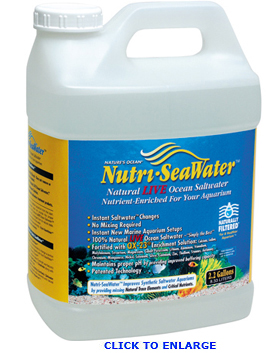
Maintains proper pH by providing improved buffering capacity
ACCEPT NO STUBSTITUTE! · ORIGINAL PATENTED TECHNOLOGY
U.S. PATENT #6,376,229
Advantages
•
NO WAITING... JUST ADDFISH!®
•
Nutri-Seawater® is Naturally Filtered - Does not remove
or modify what mother nature intended.
•
Nutri-Seawater® is 100% Natural Live Ocean Seawater®.
•
Contains natural Live marine Heterotrophic, Autotrophic and Chemolithotrophic bacteria to provide a proper inorganic balance.
•
Fortified with QX-23® Enriched Solution.
•
Reduces the need for additional saltwater treatment products.
•
Note: Nutri-Seawater® creates a healthier aquarium from the start. Freshly mixed synthetic Saltwater does not provide the proper chemical requirements provided by 100% NaturalLive Ocean Seawater® .
•
Saltwater 'treated with ozone or UV" is changed from its natural state. Those treatments alter the chemical nature of the water.
•
Charcoal filtration removes required trace elements Nutri-SeaWater® replaces missing natural LIVE marine bacteria, trace elements and critical nutrients
Recommended Usage
•
Nutri-SeaWater® can be added to existing Synthetic Saltwater Aquariums to provide the missing natural Live heterotrophic marine bacteria, natural trace elements and natural critical nutrients needed "For a Healthier Aquarium"®.
•
For Best Results use 100% Nutri-SeaWater
•
For routine water changes: It is recommended to change a portion of your aquarium water 10-20% of volume regularly with Nutri-SeaWater® to restore your marine system to Nature's Ocean®.
•
For New Aquarium Setup: To achieve Instant Cycling® use Nature's Ocean® Bio-Activ Live®AragoniteReef Sand or Substrate along with Nutri-SeaWater® to provide the perfect start
It is very important in the maintenance of a marine aquarium that the environment be replenished regularly. The best means of accomplishing this is to change 15 percent to 20 percent of the water once a month. The ideal replacement water is 100% natural ocean saltwater. Natural ocean saltwater contains all the essential elements and micronutrients required by fish, coral and invertebrates that inhabit your aquarium. In addition, natural ocean water contains LIVE bacteria necessary for the rapid removal of biologic wastes.
A critical process in establishing a new marine aquarium system is the culturing of enough bacteria to adequately break down waste products. Nitrification is the first step in this very important process. Nitrification is carried out by unrelated groups of heterotrophic and chemolithotrophic bacteria. The first group converts ammonia to nitrite, which is then converted to nitrate by the second group. The best-known catalysts of these reactions are Nitrosomonas and Nitrobacter, respectively, although other groups have also been identified (Belser 1979, Bergey's 1989). Taken together, these bacteria can be used to ameliorate damage to the aquarium environment by reducing the ammonia content, which is generated as biologic waste. Effective ammonia removal is extremely important as ammonia is toxic to aquatic life and it creates a large demand for oxygen (USEPA 1993).
Nature's Ocean Live Nutri-Seawater® contains live, naturally-occurring planktonic bacteria, which makes it the best product for monthly water changes. Nutri-Seawater® can immediately remove biologic waste products that have built up in the aquarium environment, and because it contains live bacteria, it can rapidly reduce the generation of new waste products.
For New Aquarium Setups: To achieve Instant Cycling® use Nature's Ocean® Bio-Activ Live® Aragonite Reef Sand or Substrate along with Nutri-SeaWater® to provide the perfect start.
What keeps the bacteria alive in Nutri-Seawater®
Bacteria are remarkably adept at surviving feast and famine, and are capable of adjusting their needs to accommodate highly diverse environments. Scientific inquiry has discovered a number of the microbial characteristics that facilitate bacteria's agile adaptations to changing environments. We have investigated this phenomenon and invented new, patented methodology to preserve live bacteria in the marine environment – QX-23®. As soon as it is added to your aquarium, Nutri-Seawater® fortified with QX-23 keeps the planktonic bacteria alive, primed and ready to remove harmful metabolic end products and restore essential elements and micronutrients to optimum levels. Each gallon of Nature's Ocean Live Nutri-Seawater® contains more than 11 million live planktonic bacteria, and the following critical elements:
Filtration systems that combine the use of ozone and ultra-violet irradiation destroy all bacteria and helpful microorganisms leaving the water DEAD, and unable to cycle the wastes from your aquarium.
Critical Element
Concentration(Micrograms/Liter)
Critical Element
Concentration(Micrograms/Liter)
Aluminum
43.65
Manganese
1.650
Antimony
0.20325
Molybdenum
13.690
Bromide
97,500
Nickel
4.695
Cadmium
0.129
Potassium
664,500
Calcium
420,000
Selenium
1.147
Chloride
29,055,000
Silver
0.032
Chromium
1.514
Sodium
16,155,000
Cobalt
0.070
Strontium
15,000
Iodine
21.600
Thallium
0.0093
Iron
14.985
Tin
0.04125
Lithium
278.250
Vanadium
2.423
Magnesium
2,085,000
Zinc
24.525
*This product is in it's natural state we did not alter it, levels may vary.
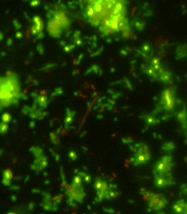
Nutri-Seawater® Live Bacteria Observed under Fluorescent Microscopy
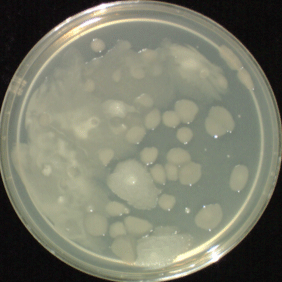
Growth of LiveBacteria From Nutri-Seawater®Samples
In addition, when this dead saltwater is further treated with charcoal it is stripped of essential elements and nutrients required for a healthy aquarium. That is why there are so many aquarium water additives on the market today. Nutri-Seawater® is 100% natural ocean water that includes all the right bacteria and essential elements – eliminating the need for additional biologic and chemical additives.
More than two years of research have gone into the generation of Nutri·Seawater®. To ensure the quality and consistency of this product, regular analysis of the water is performed by an independent laboratory.
The salinity level of this product is natural (untouched) from the ocean. If you desire a lower salinity level add Reverse Osmosis water.
Nature’s Ocean LiveNutri-Seawater®
Characteristic:
Measurement
pH
8.3
Specific Gravity
1.027
Appearance
Clear
Malodor
None
Live Bacteria per
Gallon of Saltwater
> 11,000,000
References:
Belser, L. W.
(1979). Population Ecology of Nitrifying Bacteria. Ann. Rev.
Microbiol.33:309-333.
Bergey’s
Manual of Systematic Bacteriology: Volume 3 (1989) Edited by James T. Staley and John G. Holt, Williams &
Wilkins, Baltimore.
United States
Environmental Protection Agency (1993). Manual: Nitrogen
Control, Manual EPA/625/R-93/010, Office of Research and
Development, Office of Water, Washington DC, USA.
Answer: Nature’s Ocean Live Nutri-Seawater® contains live, naturally-occurring planktonic bacteria,
which makes it the best product for monthly water changes.
Nutri-Seawater® can immediately remove biologic waste products that have
built up in the aquarium environment, and because it
contains live nitrifying bacteria, it can rapidly reduce
the generation of new waste products. Back To TopPrint Page
2-Question. What are the essential elements of Nutri Seawater?
Answer:The
essential elements of Nutri Seawater are as follows: Calcium, Iodine, Molybdenum, Strontium, Magnesium, Cobalt
Potassium, Vanadium, Chromium, Manganese, Nickel,
Selenium, Silver, Cadmium, Zinc, Thallium, Stannus,
Antimony.
Elemental Analysis
Micrograms/liter
Nutri Seawater
Calcium
420,000
Iodine
21.600
Magnesium
2,085,00
Strontium
15000
*This product is in it's natural state we did not alter it, levels may vary.
3-Why
Nutri-Seawater and not pumped ocean saltwater?
Answer: Pumped Ocean saltwater is not controlled so it can be full
of pollutants and parasites if it is not properly filtered;
Nutri-SeaWater is naturally filtered® and remains in its
natural state making it the ideal replacement for pumped
Ocean saltwater Back To
TopPrint Page
4-Question. How is it used?
Answer: Nutri-SeaWater can be added to existing Synthetic Saltwater
Aquariums to provide the missing natural Live heterotrophic
marine bacteria, natural trace elements and natural critical
nutrients needed “For a Healthier Aquarium®”. For
routine water changes: It is recommended to change a portion of
your aquarium water (10-20% of volume) monthly with Nutri-SeaWater
to restore your marine system to Nature’s Ocean.
For Nano reef systems: Use 100% Nutri-Seawater.
For New aquarium Setups: To achieve Instant Cycling use Natures
Ocean Bio-Activ Live Aragonite Reef
Sand to provide the perfect start. Back To
TopPrint Page
5-Question. Where does Nutri Seawater come from?
Answer: Nutri-Seawater®
is 100% Natural Live Ocean
Seawater®. Nature’s Ocean Live Nutri-Seawater™ contains live, naturally-occurring
planktonic bacteria, which makes it the best product for
monthly water changes. Back To TopPrint Page
6-Question. What are the benefits of using Nutri Seawater?
Answer: Some of the benefits of using NutriSeawater are as follows:
You don’t
need to wait days for the tank water to cycle before adding your
fish. Just put the NutriSeawater in the tank and add your fish
in the same day.
Nutri-Seawater®
is Naturally Filtered and does not remove or modify what Mother
Nature intended.
Nutri-Seawater reduces the need for additional saltwater
treatment products.
Nutri-Seawater®
is 100% Natural Live Ocean Seawater® that contains
natural Live marine Heterotrophic, Autotrophic and
Chemolithotrophic bacteria to provide your tank with a proper
organic balance.
Nutri-SeaWater® replaces missing natural LIVE marine bacteria,
trace elements and critical nutrients needed to help improve
tank water quality Back To
TopPrint Page
7-Question. What keeps the bacteria alive in NutirSeawater?
Answer: Bacteria are remarkably adept at surviving feast and
famine, and are capable of adjusting their needs to
accommodate highly diverse environments. Scientific
inquiry has discovered a number of the microbial
characteristics that facilitate bacteria's agile
adaptations to changing environments. We have
investigated this phenomenon and invented new, patented
methodology to preserve live bacteria in the marine
environment – QX-23®.
As soon as it is added to your aquarium, Nutri-Seawater® fortified with QX-23 keeps the planktonic bacteria
alive, primed and ready to remove harmful metabolic end
products and restore essential elements and micronutrients
to optimum levels. Back To
TopPrint Page
8-Question. What does it look like?
Answer: Nutri seawater is 100% natural live ocean saltwater
nutrient enriched for your aquarium. That is used for the
instant cycling of aquarium tanks. To see what the
NutriSeawater Live Planktonic® Bacteria looks like under a fluorescent microscope got to this link: www.nutriseawater.com/#florescent Back To
TopPrint Page
9-Question. Who uses Nutri Seawater?
Answer: NutriSeawater
is perfect for nano systems and hobbyists wanting to make
small water changes with as little effort as possible. Back To
TopPrint Page
11-Question. When should Nutri Seawater be added to my saltwater aquarium?
Answer: For
your new aquarium setups to
achieve Instant Cycling® use Nature’s Ocean® Nutri-SeaWater along with Bio-Activ Live® Aragonite Reef Sand or Substrate to provide the perfect start. Nutri Seawater
should be a part of every monthly partial water change to ensure
essential elements are kept at appropriate levels. This ensures
that harmful nitrates will not increase to dangerous levels. Back To
TopPrint Page
12-Question. How Much Nutri Seawater Should I Use for my saltwater aquarium?
Answer: For
routine water changes: It is recommended to change
apportion of your aquarium water 10-20% of volume
regularly with Nutri-SeaWater to restore your marine
system to Nature’s Ocean. Back To
TopPrint Page
13-Question. How do you know if you are getting Nutri Seawater?
14-Question. How do I maintain my Aquarium with the Nutri Seawater?
Answer: It is
very important in the maintenance of a marine aquarium
that the environment be replenished regularly. The best
means of accomplishing this is to change 15% to 20% of the
water once a month. The ideal replacement water is our
NutriSeawater 100% natural ocean saltwater. Natural ocean
saltwater contains all the essential elements and
micronutrients required by fish, coral and invertebrates
that inhabit your aquarium. In addition, natural ocean
water contains LIVE bacteria necessary for the
rapid removal of biologic wastes. Back To
TopPrint Page
15-How
long will the Nutri Seawater last?
Answer: Nature’s Ocean®
NutriSeawater has a shelf life of 12 months. Back To
TopPrint Page
16- What are
some other recommended products for my saltwater fish tank?
Answer: Every marine aquarist
who wishes to set up a natural biological filter will use Nature’s Ocean® Bio-Activ Live™ Aragonite Live Sand and Reef Substrates. It is also used by saltwater
fish farms, saltwater shrimp farms and saltwater lobster farms. Back To
TopPrint Page

 Natural